

The Ultimate Flea Market Vendor Guide for India

Table of Contents
"Planning to sell at a flea market in India? Discover the ultimate vendor guide with expert setup tips, pricing strategies, marketing ideas, checklists, UPI payment tips, and everything you need for a successful pop-up market."
How do you prepare for a flea market?
To prepare for a flea market successfully, you must complete four essential steps: 1) Research and book the right pop-up market for your target audience, 2) Curate a visually appealing stall layout with clear signage, 3) Stock up on adequate inventory and reliable payment methods (like a UPI QR code), and 4) Market your presence on social media at least two weeks before the event.
In this ultimate guide, we will dive deep into everything you need to know about setting up the perfect vendor stall in India...
Everything You Need to Prepare, Sell More & Build a Successful Pop-Up Brand
Whether you're selling handmade crafts, fashion, jewellery, home décor, food, art, candles, skincare, books, or vintage collectibles, this comprehensive guide will help you prepare for your next pop-up market like a professional.
Learn how experienced vendors organize their stalls, attract customers, price products, accept digital payments, market themselves before the event, and turn one-time shoppers into loyal customers.
Updated for 2026
Based on Real Pop-Up Market Experience Across India
Introduction

According to recent retail trends in India, weekend markets have become one of the fastest-growing opportunities for small businesses, creators, artists, and independent brands across India. Cities like Bangalore, Mumbai, Delhi, Hyderabad, Chennai, Pune, and Ahmedabad now host dozens of curated pop-up markets every month, attracting thousands of shoppers looking for unique products that aren't available in traditional retail stores.
Why Customers Love Them
- Discover unique handmade products
- Support local businesses
- Meet the creators behind the products
- Enjoy food, live music, and entertainment
- Find limited-edition items
Why Vendors Love Them
- Lower investment than opening a retail store
- Direct customer interaction & instant feedback
- Build brand awareness rapidly
- Test new products before large-scale production
- Generate content for social media
Phase 1: Preparation & Planning
1. Choosing the Right Market for Your Business
Not every market attracts the same audience. One of the biggest mistakes first-time vendors make is participating in every available event without considering whether the audience matches their products.
Handmade Jewellery
Best in Lifestyle Markets with premium footfall.
Organic Food
Best in Community Markets and farmers markets.
Fashion & Apparel
Best in Mall Pop-Ups with fitting rooms nearby.
Organizer Tip: If you're participating in your first market, don't choose based only on the lowest stall fee. A well-organized event with strong promotion and the right audience can generate significantly better sales than a cheaper event with limited visitors.
Average Vendor ROI by Market Category
Estimated return on investment (Stall Fee vs Revenue) across different venue types.
2. Planning Your Inventory Like a Professional

Many first-time vendors either bring too little inventory or overload their stalls with too many products. Both mistakes reduce sales. Instead, organize your products into three categories:
Ideal Inventory Distribution
The golden ratio for maximizing sales and minimizing leftover stock.
1. Hero Products
Your best-selling items. These should immediately catch attention (e.g., Premium jewellery, Customized gifts, Signature desserts).
2. Mid-Range Products
Affordable products customers add naturally. If they buy a ₹1,000 candle box, they might also buy ₹300 wax melts.
3. Impulse Buys
Priced between ₹99 and ₹199 (e.g., Keychains, Stickers, Mini soaps). Placed at the edge of the table to encourage quick buys.
3. Professional Booth Design: Your Stall Is Your Storefront
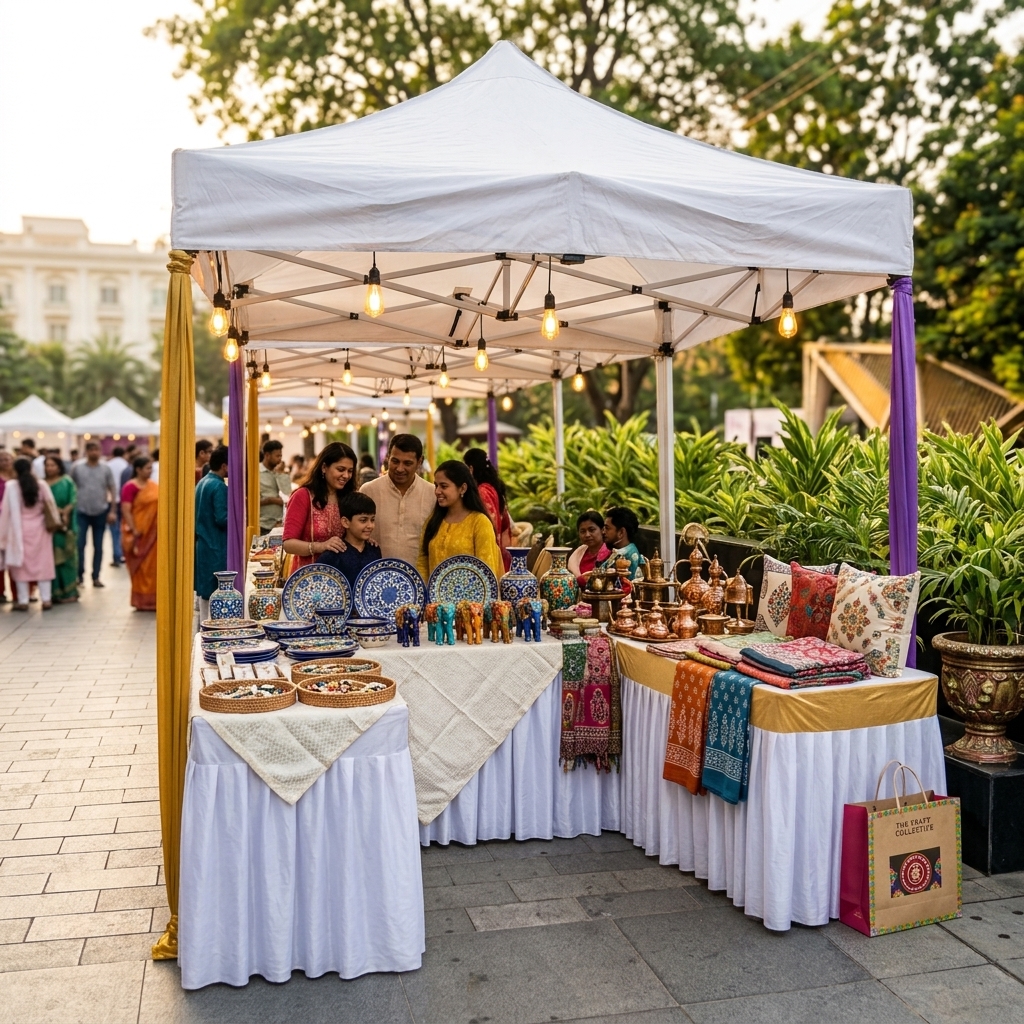
At a pop-up, your stall is your retail store. Visitors here are constantly moving. You have only 3–5 seconds to grab someone's attention before they continue walking.
Divide Into Shopping Zones
-
1
Attraction Zone (Front) Best-selling products and ₹99 impulse buys to make people stop walking.
-
2
Discovery Zone (Middle) New arrivals, seasonal collections, and interactive samples.
-
3
Premium Zone (Back) Highest-value products like gift boxes and designer apparel.
Use Height to Stand Out
Flat tables make products disappear into the crowd. Create visual levels using:
Different heights create depth and help every single product stand out to passersby.
Phase 2: Event Day Execution
4. UPI Payment Setup & Cash Management

In India, digital payments have become the preferred way to pay at events. If customers have to wait because your payment setup is confusing, they may simply move on.
Multiple QR Codes
Print and laminate codes. Place them at the front, the checkout counter, and side displays.
Use a QR Stand
Professional acrylic QR stands look more trustworthy, stay upright, and keep the table organized.
Keep Cash Ready
Carry change (₹10, ₹20, ₹50, ₹100 notes) to avoid losing customers who prefer cash.
Verify Smoothly
Use a UPI soundbox or smartwatch notifications to confirm transactions without checking your phone.
5. Event Day Timeline
Planning your day keeps you calm and helps you avoid last-minute mistakes.
Typical Market Footfall & Sales Velocity
Data based on weekend evening pop-up markets in metro cities.
8:00 AM Vendor Check-in
Arrive early, locate your stall, and check electricity connections.
8:30 AM Stall Setup
Set up your risers, arrange products by zones, and test your lighting.
10:00 AM Final Tests
Scan your own UPI QR code to ensure it works. Take professional photos before crowds arrive.
Event Opening
Stand up, smile, and welcome your first customers!
6. Collecting Customer Data (Without Being Pushy)
Turn Visitors into Loyal Fans
The sale shouldn't end at checkout. Instead of saying "Give me your number," ask:
"Would you like to receive updates about our new collections and upcoming markets?"
Offer a small incentive like 10% off their next purchase or early access to new collections. Use a QR code displayed clearly on your table that links directly to your WhatsApp Community or newsletter signup page.
Scan to Join
Phase 3: Advanced Vendor Strategies
7. Visual Merchandising Techniques That Increase Sales

Professional retailers spend millions on visual merchandising because, as Shopify's retail studies show, presentation directly influences buying decisions. If you want to book a flea market stall that stands out, you need to treat your table like a premium boutique.
- Tell a Story: Create themed collections. Instead of just grouping all candles or soaps together, create a "Relaxation Collection" (Lavender Candle + Essential Oil + Bath Salt).
- Group Products by Color: A rainbow of random colors looks cluttered. Arrange products in coordinated color blocks (e.g., Earth Tones, White Collection) to make your display look premium.
- Keep Touch-Friendly Products Accessible: Customers are more likely to buy products they can pick up. Avoid putting everything behind decorative barriers.
- Refresh Every Hour: As products sell, fill empty spaces, straighten displays, and wipe dusty shelves.
8. Lighting Secrets That Increase Sales

Lighting is one of the most overlooked aspects of a successful stall. Products that look ordinary under poor lighting can appear premium with the right setup.
- Indoor Markets: Use warm LED spotlights, rechargeable LED panels, or clip-on lights.
- Outdoor Evening Markets: Use fairy lights, LED strip lights, or portable battery lights.
- Avoid Harsh White Light: Warm lighting generally creates a more inviting atmosphere for lifestyle products.
- Backup Power: Always carry a high-capacity power bank, an extension board, and a multi-plug. Never depend entirely on the event organizer for stable electricity throughout the day.
9. Technology Checklist Every Vendor Should Carry
Your smartphone is your cash register, your marketing tool, and your calculator. Be prepared with the following essentials:
10. Customer Engagement Strategies That Actually Work

Great vendors don't wait for customers to start conversations. They create welcoming, pressure-free interactions.
11. Sales Psychology: Small Changes That Increase Revenue
Scarcity
Use signs like "Only 5 Left" or "Handmade in Small Batches" to encourage quicker decisions.
Social Proof
Display tags like "Best Seller" or "Most Gifted Product" to help new customers make choices with confidence, a psychological trigger proven by Harvard Business Review.
Encourage Photos
Create one beautifully styled corner with good lighting where customers naturally want to take pictures. Free exposure!
Phase 4: Survival & Post-Event
12. The Ultimate Vendor Survival Kit

No matter how well you've planned, event days are unpredictable. A well-packed survival kit can save your day.
Your Emergency Kit Should Include:
- ✓Zip ties & double-sided tape
- ✓Scissors & utility knife
- ✓Safety pins & rubber bands
- ✓Needle, thread & super glue
- ✓Thick marker & extra price tags
- ✓Hand sanitizer & first aid kit
13. Common Mistakes That Cost Vendors Sales
-
⚠️
Arriving LateLate arrivals often rush their setup, miss early customers, and create a cluttered first impression.
-
⚠️
Poor PricingCustomers shouldn't have to ask for every price. Clearly label products.
-
⚠️
Sitting Behind the TableCustomers may feel hesitant to approach. Stand, smile, and stay engaged.
-
⚠️
No BrandingWithout visible branding, customers may remember the product but forget the business. Display your logo, Instagram handle, and QR code.
14. Post-Event Follow-Up Strategy

What you do after the event often determines your long-term success. If you want to successfully book your next pop-up market, you need to analyze your performance.
Within 24 Hours
- • Thank attendees on social media (Engagement is highest within 24 hours per Mailchimp data)
- • Share event photos & stories
- • Answer pending enquiries
- • Organize customer contacts
Within One Week
- • Review best-selling products
- • Calculate revenue & overall profit
- • Record lessons learned in journal
- • Book your next event
Frequently Asked Questions (FAQ)
1. How much does it cost to book a flea market stall in India?
2. What products sell best at flea markets?
3. Should I accept UPI payments?
4. Do I still need to carry cash?
5. How early should I arrive?
6. Do I need GST to sell at a flea market?
7. How do I attract more visitors to my stall?
8. Should I offer discounts?
9. Can I participate if I'm a new business?
Frequently Asked Questions (FAQ)
How much does a flea market stall cost in India?
Flea market stall prices in India typically range from ₹3,000 to ₹15,000 per day depending on the city, the size of the event, and the location (e.g., premium malls vs open grounds).
What sells best at flea markets?
Handcrafted jewelry, sustainable fashion, artisanal food items, home decor, and personalized gifts consistently perform best at pop-up markets.
Do I need a GST number to sell at a flea market?
For small, occasional pop-up vendors earning below the threshold, a GST number may not be strictly required, but many premium organizers now request it for formal invoicing. Always check with the specific event organizer.

